
Research Use Only. This article and the products referenced are intended strictly for laboratory and research purposes. Nothing here constitutes medical advice, and no compound discussed is intended for human or animal consumption.
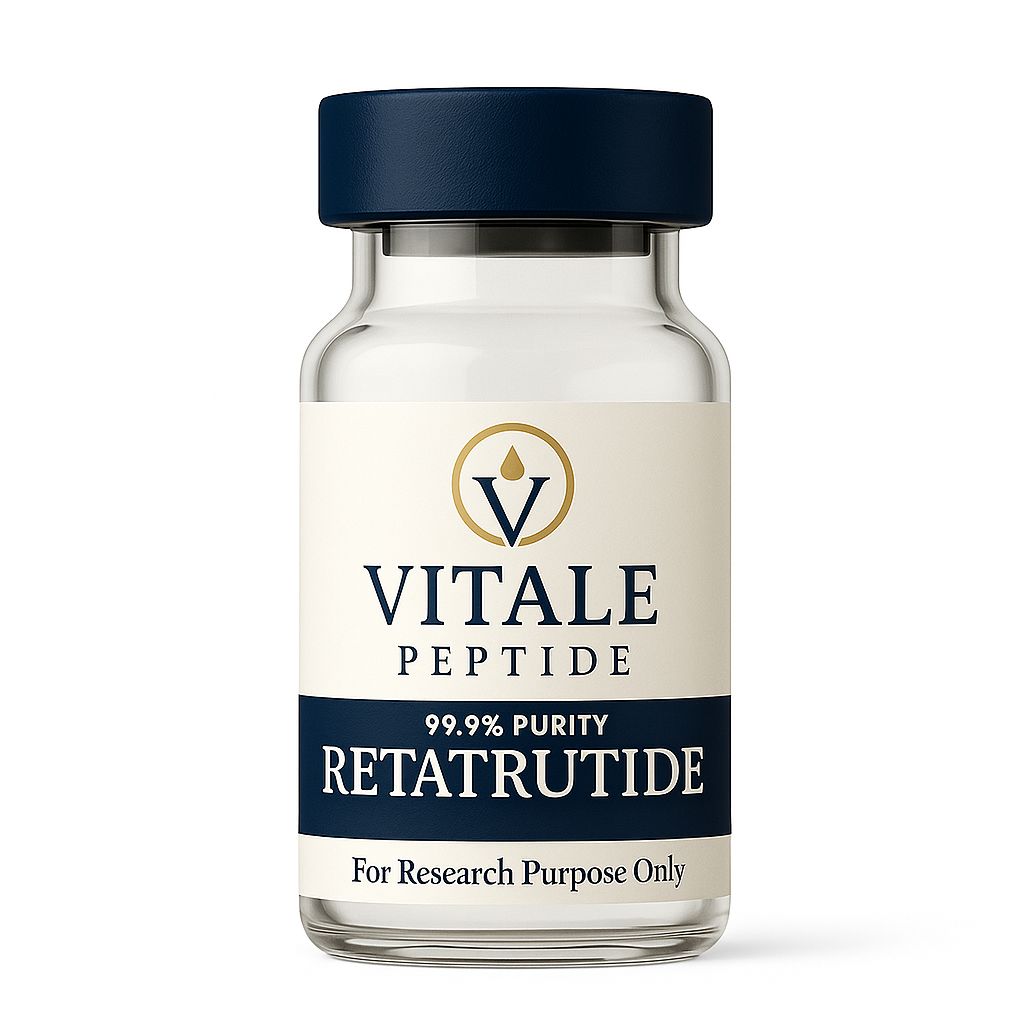
Retatrutide (GLP-3) has become one of the most searched terms among researchers studying metabolic hormone pathways, largely because “GLP-3” is a term that keeps appearing in scientific forums and search queries without a clear definition. Specifically, in this guide, we explain what Retatrutide actually is, how it differs from GLP-1 and GLP-2, why some researchers call it “GLP-3,” and what current research reveals about its receptor activity. Overall, whether you’re a lab researcher, a university procurement officer, or simply trying to understand the terminology, this article gives you a clear, accurate, and up-to-date picture — sourced from current scientific literature and manufacturer research documentation.
At Vitale Peptide, we supply research-grade Retatrutide to laboratories and institutions that need dependable, verified compounds for controlled studies. Before you evaluate a supplier or a study protocol, it helps to understand exactly what this molecule is and isn’t.
Retatrutide is an investigational research peptide classified as a triple hormone receptor agonist, meaning it is studied for its simultaneous activity at three distinct receptor sites: the GLP-1 receptor, the GIP (glucose-dependent insulinotropic polypeptide) receptor, and the glucagon receptor. This tri-agonist design is what sets Retatrutide apart from single-target compounds and is the primary reason it has drawn significant attention in metabolic and endocrine research literature.
It’s important to note that Retatrutide is not an FDA-approved medication. It remains an investigational compound under study, and any use outside of a licensed research or laboratory setting falls outside its intended purpose. Vitale Peptide supplies Retatrutide exclusively for in-vitro and preclinical research applications — not for human or animal administration.
A quick search for “GLP-3” often turns up more confusion than clarity, and for good reason: no scientific body officially recognizes GLP-3 as a hormone, receptor, or drug class.. Unlike GLP-1 (glucagon-like peptide-1) and GLP-2 (glucagon-like peptide-2), which are naturally occurring gut hormones with well-defined physiological roles, “GLP-3” is an informal shorthand that has emerged in research and consumer discussions to describe multi-receptor agonists like Retatrutide.
Here’s the distinction researchers should keep in mind:
Understanding this distinction matters for anyone designing a research protocol or writing a literature review — using precise terminology (triple hormone receptor agonist) rather than the shorthand improves both scientific accuracy and searchability of your own research documentation.
Research into Retatrutide centers on its unique ability to engage three receptor systems at once:
Studied for its role in appetite-signal regulation and insulin secretion pathways in preclinical models.
GIP is a second incretin hormone studied alongside GLP-1 for its potential complementary role in glucose metabolism and energy balance regulation.
Unlike GLP-1-only compounds, Retatrutide’s glucagon receptor engagement draws particular research interest because glucagon signaling relates to energy expenditure pathways — an area metabolic researchers actively explore
esearchers studying multi-receptor agonism often ask whether combined receptor activity produces additive or synergistic effects compared to single-target compounds — a question the scientific literature is still actively investigating.
| Compound | Receptor Target(s) | Primary Research Focus |
|---|---|---|
| GLP-1 | GLP-1 receptor | Insulin signaling, appetite regulation, glucose control |
| GLP-2 | GLP-2 receptor | Intestinal lining repair, nutrient absorption |
| Retatrutide (“GLP-3”) | GLP-1, GIP, glucagon receptors | Multi-pathway metabolic and energy expenditure research |
This table highlights why direct comparisons between these compounds can be misleading if researchers don’t account for the differing receptor targets — each hormone pathway serves an entirely different physiological function in research models.
Retatrutide remains under active investigation, and its full research profile continues to develop. Key points researchers should understand:
Because the compound is still investigational, researchers should treat findings as preliminary and consult primary literature and manufacturer research documentation before designing new studies.
Laboratories and institutions studying Retatrutide are typically investigating one or more of the following areas:
All of these applications require a compound with verified purity and consistent batch-to-batch characteristics — which is why sourcing matters as much as the research question itself.
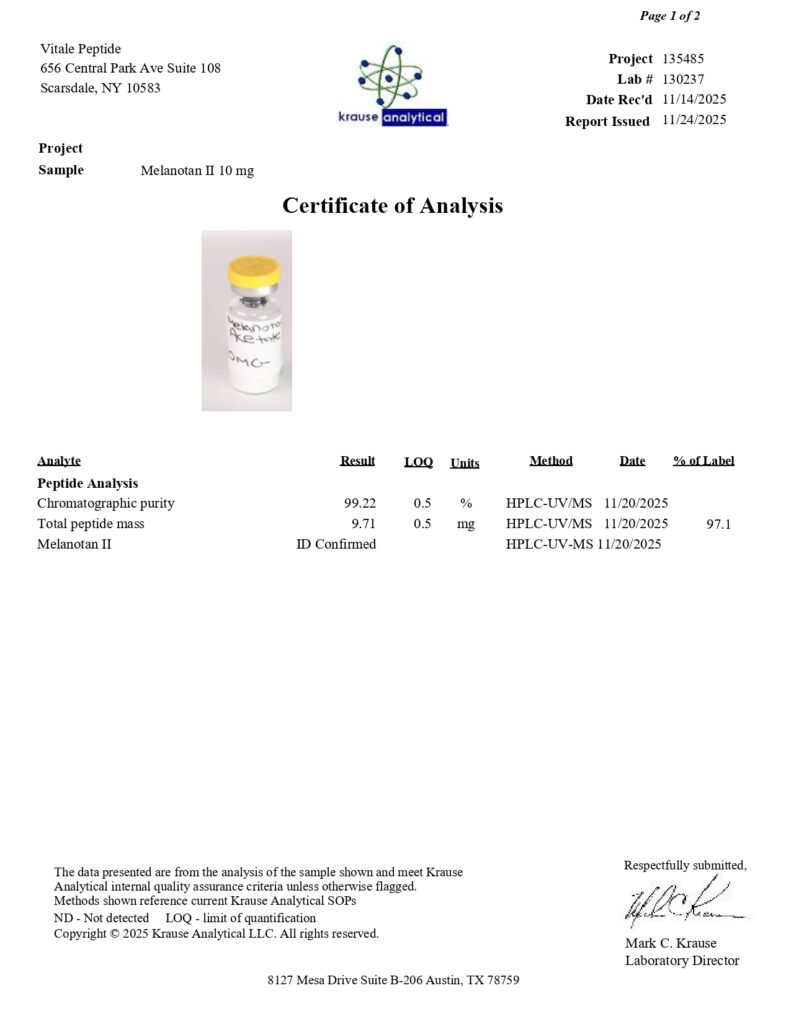
Research integrity depends on knowing exactly what’s in the vial. When evaluating a supplier for Retatrutide or any research peptide, look for:
At Vitale Peptide, every batch of Retatrutide we supply includes documentation researchers can reference and cite in their own quality-control processes.
Peptide stability is sensitive to temperature, light, and moisture, so proper handling protocols matter for research validity:
Is GLP-3 a real hormone? No. GLP-3 is not an officially recognized hormone or receptor class. It’s an informal term sometimes used to describe triple-agonist research compounds like Retatrutide, which actually targets the GLP-1, GIP, and glucagon receptors.
What makes Retatrutide different from GLP-1-only compounds? Retatrutide is studied for simultaneous activity at three receptor types (GLP-1, GIP, and glucagon), while standard GLP-1 compounds target only one receptor pathway.
Is Retatrutide approved for human use? No. Retatrutide is an investigational compound and is not approved for human or animal administration. It is supplied strictly for laboratory and research use.
How should Retatrutide be stored for research purposes? Lyophilized peptide should be stored at -20°C, and reconstituted peptide should be kept refrigerated at 2–8°C and used within the supplier’s recommended timeframe.
Does Vitale Peptide provide documentation for research compliance? Yes. Every batch includes a Certificate of Analysis (COA) confirming purity and identity, which researchers can reference for their own quality-control records.
Can Retatrutide be compared directly to GLP-2? Not meaningfully — GLP-2 targets a completely different receptor and research area (intestinal repair and nutrient absorption), unrelated to the metabolic pathways studied with Retatrutide.
Where can researchers find peer-reviewed information on multi-receptor agonists? Peer-reviewed journals and manufacturer research pages (linked in the sources below) are the most reliable starting points for current literature.
Retatrutide — often searched as “GLP-3” — represents one of the more scientifically interesting developments in metabolic hormone research due to its triple receptor activity across GLP-1, GIP, and glucagon pathways. While the “GLP-3” label isn’t scientifically accurate, understanding why it’s used helps researchers communicate more precisely and search the literature more effectively. As with any investigational compound, results should be treated as preliminary, and sourcing from a supplier that provides verified purity documentation is essential to reliable, reproducible research.
Looking for research-grade Retatrutide with full batch documentation? Browse our Retatrutide research peptide listing or contact our team to request a Certificate of Analysis before you order.
Research Use Only. Not for human or animal consumption. This article is intended for informational and research-context purposes only.