
Research Use Only. This article and the products referenced are intended strictly for laboratory and research purposes. Nothing here constitutes medical advice, and no compound discussed is intended for human or animal consumption.
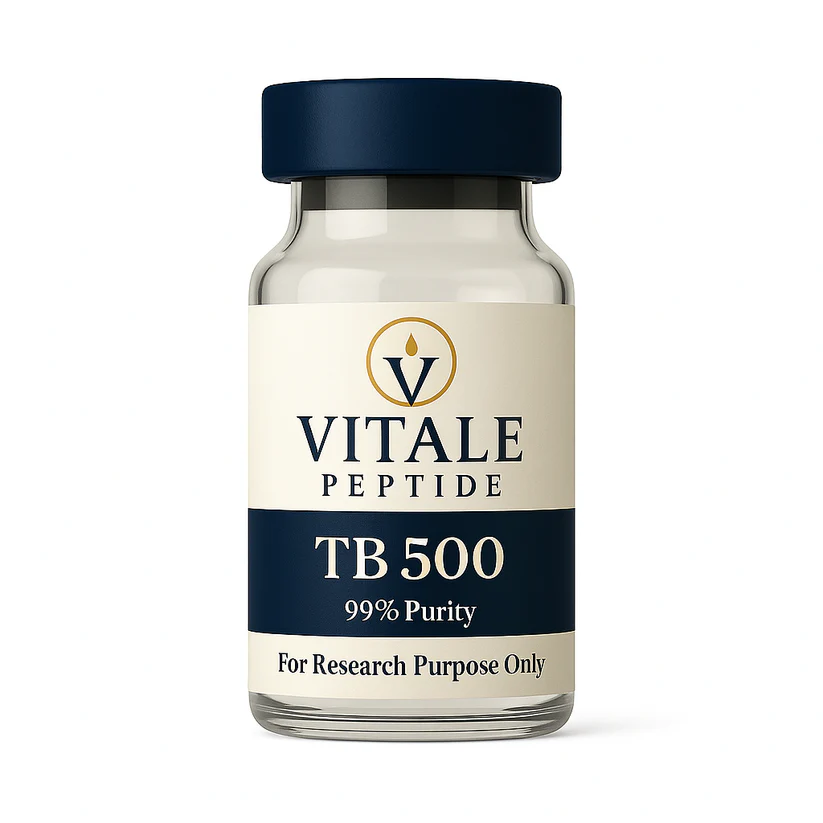
TB-500 draws consistent research interest because it isolates the single most functionally important region of a much larger natural protein: Thymosin Beta-4. In this guide, we explain what TB-500 actually is, how its actin-binding mechanism works at the cellular level, what current published research shows, and how it compares structurally to other regenerative research peptides like BPC-157. Additionally, we’ll walk through sourcing and storage considerations, since compound integrity directly affects research reproducibility. Whether you’re a lab researcher, a procurement officer, or simply researching the terminology, this guide draws on current peer-reviewed literature and manufacturer documentation.
Vitale Peptide supplies research-grade TB-500 to laboratories and institutions that need dependable, verified compounds for controlled studies. Before evaluating a supplier or designing a study protocol, it helps to understand exactly what this fragment is and how it behaves at the molecular level.
TB-500 is a synthetic peptide fragment corresponding to the actin-binding domain of Thymosin Beta-4 (Tβ4), a naturally occurring 43-amino acid protein found throughout human and animal tissue. Because the full Tβ4 protein is one of the most abundant intracellular proteins in mammalian cells, researchers have spent decades characterizing its role in actin regulation, and TB-500 was developed to isolate the specific region responsible for that activity.
Structurally, TB-500 corresponds to a short fragment near the N-terminal actin-binding region of the parent protein — the segment researchers have identified as critical for G-actin sequestration. Since this fragment retains much of the parent protein’s core biological activity while offering better stability for laboratory use, it functions as a practical research tool for studying actin-dependent cellular processes without requiring the full-length native protein.
Importantly, TB-500 has not completed human efficacy trials, and neither the fragment nor full-length Tβ4 is approved for human therapeutic use. Vitale Peptide supplies TB-500 exclusively for in-vitro and preclinical research applications — not for human or animal administration.
TB-500’s research value centers on one well-characterized biochemical mechanism: G-actin sequestration.
Actin exists in two forms inside cells: monomeric G-actin and polymerized F-actin filaments. TB-500 binds monomeric G-actin with high affinity, forming a 1:1 complex that keeps a portion of the cell’s actin pool from polymerizing prematurely.
Because actin polymerization drives the formation of lamellipodia and filopodia — the structures cells extend when migrating — regulating the available G-actin pool directly influences how readily a cell can move. Researchers studying cell migration models frequently use this property to investigate wound-repair and regenerative pathways.
Beyond direct actin binding, published research has also linked Tβ4-derived fragments to angiogenesis-related signaling, including upregulation of vascular endothelial growth factor (VEGF) pathways involved in new blood vessel formation.
Taken together, these findings explain why TB-500 shows up so often in cell-motility and tissue-repair research rather than in receptor-binding studies like many other peptides.
{ add image here — diagram showing G-actin sequestration preventing F-actin polymerization }
Researchers frequently study TB-500 and BPC-157 together, since both appear in regenerative-research literature, but they work through entirely different mechanisms.
| Compound | Origin | Primary Mechanism | Research Focus |
|---|---|---|---|
| TB-500 | Actin-binding fragment of Thymosin Beta-4 | G-actin sequestration, cytoskeletal regulation | Cell migration, angiogenesis, tissue repair |
| BPC-157 | Synthetic fragment derived from a gastric protein sequence | Nitric oxide and VEGFR2-Akt-eNOS signaling pathways | Fibroblast migration, gut and tendon repair models |
Because these two compounds act through unrelated pathways, comparing results between TB-500 and BPC-157 studies requires accounting for the distinct biological mechanism each one engages, rather than assuming interchangeable effects.
TB-500 sits on a substantial body of preclinical literature, though the evidence base has important limits researchers should understand:
Since most available data comes from animal and cell-culture models rather than human trials, researchers should treat TB-500’s regenerative research findings as preclinical and mechanistically grounded, not clinically established.
Laboratories and institutions studying TB-500 typically investigate one or more of the following areas:
Since all of these applications depend on a compound with verified purity and consistent batch-to-batch characteristics, sourcing quality matters just as much as the research question itself.
Researchers should also be aware of TB-500’s current regulatory classification. In the United States, TB-500 falls under FDA 503A Category 2 bulk drug substance status, meaning it sits outside standard compounding pathways available to licensed pharmacies. It also appears on the World Anti-Doping Agency’s Prohibited List. Neither classification affects its legitimate use as a laboratory research compound, but researchers designing studies or evaluating suppliers should factor this regulatory context into their institutional compliance documentation.
Research integrity depends on knowing exactly what’s in the vial. Therefore, when evaluating a supplier for TB-500 or any research peptide, look for:
Vitale Peptide includes this documentation with every batch of TB-500 we supply, so researchers can reference it directly in their own quality-control processes.
Peptide stability depends heavily on temperature, light, and moisture control, so proper handling protocols directly affect research validity:
What is TB-500 studied for in research? Researchers primarily study TB-500 for its role in actin cytoskeleton regulation, cell migration, angiogenesis, and tissue-repair signaling pathways in cell and animal models.
Is TB-500 the same as Thymosin Beta-4? Not exactly. Thymosin Beta-4 is the full 43-amino acid naturally occurring protein, while TB-500 corresponds to the specific actin-binding fragment that retains much of the parent protein’s core biological activity.
How does TB-500 differ from BPC-157? TB-500 works through G-actin sequestration and cytoskeletal regulation, while BPC-157 acts primarily through nitric oxide and VEGFR2-Akt-eNOS signaling pathways — two distinct mechanisms studied in overlapping regenerative-research contexts.
Has TB-500 completed human clinical trials? No. As of current published literature, no completed human randomized controlled trials have examined the TB-500 fragment specifically for tissue-repair applications; existing data comes primarily from cell and animal models.
How should researchers store TB-500? Researchers should store lyophilized peptide in a cool, dry place away from light, refrigerate reconstituted peptide at 2–8°C, and use it within the supplier’s recommended timeframe.
Does Vitale Peptide provide documentation for research compliance? Yes. Every batch includes a Certificate of Analysis (COA) confirming purity and identity, which researchers can reference for their own quality-control records.
TB-500 offers researchers a well-characterized, mechanistically grounded tool for studying actin-dependent cellular processes, with a research base spanning cell migration, angiogenesis, and wound-healing models. That said, the evidence remains overwhelmingly preclinical, and researchers should keep that distinction clear when designing studies or interpreting existing literature. As with any research compound, sourcing from a supplier that provides verified purity documentation remains essential to reliable, reproducible results.
Looking for research-grade TB-500 with full batch documentation? Browse our TB-500 research peptide listing or contact our team to request a Certificate of Analysis before you order.
Research Use Only. Not for human or animal consumption. This article is intended for informational and research-context purposes only.