
Research Use Only. This article and the products referenced are intended strictly for laboratory and research purposes. Nothing here constitutes medical advice, and no compound discussed is intended for human or animal consumption.
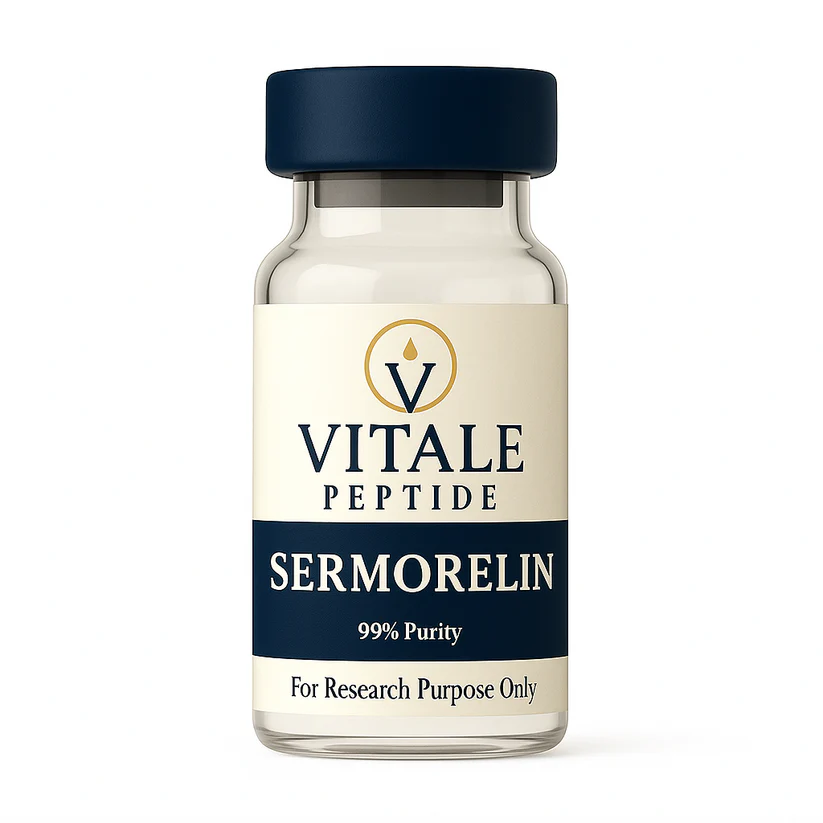
Sermorelin holds a distinctive place among GHRH analogs: unlike many research peptides, it carries a documented FDA approval history stretching back decades. In this guide, we explain what Sermorelin actually is, how its truncated GHRH structure retains full receptor activity, what current research shows, and how it compares to related analogs like Tesamorelin and CJC-1295. Additionally, we’ll cover sourcing, storage, and Sermorelin’s regulatory history, since that history sets it apart from most compounds in this research category. Whether you’re a lab researcher, a procurement officer, or simply researching the terminology, this guide draws on current published literature and manufacturer documentation.
Vitale Peptide supplies research-grade Sermorelin to laboratories and institutions that need dependable, verified compounds for controlled studies. Before evaluating a supplier or designing a study protocol, it helps to understand exactly what this molecule is and how it behaves at the receptor level.
Sermorelin is a synthetic peptide consisting of the first 29 amino acids of endogenous human growth hormone-releasing hormone (GHRH), a 44-amino-acid hypothalamic hormone. Despite representing less than two-thirds of the full-length hormone, this truncated fragment retains essentially full biological activity at the GHRH receptor — research dating back to the 1980s established that the first 29 residues are sufficient for complete receptor binding and activation.
Unlike most compounds in the research-peptide space, Sermorelin has a documented regulatory history: it received FDA approval under the brand name Geref, first for diagnostic use in evaluating pituitary growth hormone secretory capacity and later for treating idiopathic growth hormone deficiency in children. The branded product was voluntarily withdrawn from the U.S. market for commercial reasons, not safety or efficacy concerns. It’s important to note, however, that this approval history applies only to the regulated pharmaceutical product used under clinical supervision. The research-grade Sermorelin that laboratories study is a distinct, unformulated compound intended exclusively for in-vitro and preclinical research applications — not for human or animal administration.
Sermorelin’s regulatory history is worth understanding in more detail, since it distinguishes this compound from most others in GHRH-analog research:
Researchers should account for this population difference when designing studies or interpreting existing literature, since findings from pediatric GH-deficiency trials don’t necessarily generalize to other research contexts.
Sermorelin’s research value centers on a well-characterized mechanism: GHRH receptor activation at the pituitary gland.
Sermorelin binds the GHRH receptor (GHRHR) on anterior pituitary somatotroph cells, the same receptor targeted by full-length endogenous GHRH.
Receptor activation triggers a signaling cascade: adenylyl cyclase activates, cyclic AMP (cAMP) levels rise, and protein kinase A (PKA) switches on, ultimately driving transcription of the growth hormone gene.
Because Sermorelin acts as a secretagogue rather than supplying exogenous hormone directly, it prompts the pituitary to synthesize and release its own growth hormone in the body’s natural pulsatile pattern. Researchers consider this mechanism meaningful because it preserves the pituitary’s own feedback regulation, distinguishing it from direct hormone administration.
Consequently, researchers frame Sermorelin as an upstream secretagogue rather than a hormone-replacement compound — a distinction that shapes how comparator groups and study endpoints get selected.
Researchers frequently compare Sermorelin to other GHRH analogs, since all three share the same receptor target but differ meaningfully in structure and duration of action.
| Compound | Structure | Primary Research Distinction |
|---|---|---|
| Sermorelin | GHRH(1-29) fragment | Shortest active fragment; documented FDA approval history; short half-life (~12 minutes) |
| Tesamorelin | Full GHRH(1-44) + stabilizing N-terminal group | Longest researched GHRH analog; extensive clinical trial dataset in adults |
| CJC-1295 | Modified GHRH fragment, studied with or without a drug-affinity complex (DAC) | Extended half-life; studied for sustained GH pulsatility over longer intervals |
Overall, this comparison matters because researchers frequently substitute one GHRH analog for another without accounting for differences in half-life and structural modification that directly affect study design and dosing-interval assumptions in animal models.
Sermorelin’s published research spans several decades, but researchers should understand where the strongest evidence lies:
Given these limitations, researchers should treat Sermorelin’s adult-research applications as an active area of investigation rather than a settled body of evidence, and should clearly separate pediatric-deficiency findings from adult research contexts.
Laboratories and institutions studying Sermorelin typically investigate one or more of the following areas:
Since these applications require a compound with verified purity and consistent batch characteristics, sourcing quality matters just as much as the research question itself.
Research integrity depends on knowing exactly what’s in the vial. Therefore, when evaluating a supplier for Sermorelin or any research peptide, look for:
Vitale Peptide includes this documentation with every batch of Sermorelin we supply, so researchers can reference it directly in their own quality-control processes.
Peptide stability depends heavily on temperature, light, and moisture control, so proper handling protocols directly affect research validity:
{ add image here — lab freezer with organized, labeled research peptide vials } Alt Text: Research peptide vials stored in a labeled laboratory freezer Title: research-peptide-freezer-storage Caption: Proper cold storage helps preserve peptide stability for research use Description: Organized laboratory freezer storage showing labeled research peptide vials, illustrating proper cold-chain handling for compound stability.
What is Sermorelin studied for in research? Researchers study Sermorelin primarily for its GHRH receptor activity, its role in stimulating pulsatile growth hormone release, and downstream effects on IGF-1 signaling and endocrine function.
Was Sermorelin ever FDA-approved? Yes. Sermorelin was FDA-approved under the brand name Geref, both as a diagnostic test for pituitary GH secretory capacity and as a treatment for pediatric growth hormone deficiency. The branded product was later voluntarily withdrawn for commercial reasons, not safety concerns.
How does Sermorelin differ from Tesamorelin and CJC-1295? Sermorelin uses the shortest active GHRH fragment (1-29) with a short half-life, while Tesamorelin carries the full 44-amino-acid GHRH sequence with a stabilizing modification, and CJC-1295 uses a modified fragment often studied for extended half-life.
How should researchers store Sermorelin? Researchers should store lyophilized peptide at -20°C, refrigerate reconstituted peptide at 2–8°C, and use it within the supplier’s recommended timeframe.
Does Vitale Peptide provide documentation for research compliance? Yes. Every batch includes a Certificate of Analysis (COA) confirming purity and identity, which researchers can reference for their own quality-control records.
Is research-grade Sermorelin the same as the discontinued Geref product? No. Geref was a regulated, FDA-approved pharmaceutical formulation used under clinical supervision. Research-grade Sermorelin is a distinct, unformulated compound intended strictly for laboratory research.
Sermorelin occupies a unique position among GHRH analogs: a well-characterized mechanism, a documented FDA approval history, and decades of published research, yet no current commercially approved product. Researchers exploring GHRH receptor biology, pulsatile GH release, or endocrine aging models will find Sermorelin a well-grounded starting point, provided they account for the gap between pediatric-deficiency data and adult research contexts. As with any research compound, sourcing from a supplier that provides verified purity documentation remains essential to reliable, reproducible results.
Looking for research-grade Sermorelin with full batch documentation? Browse our Sermorelin research peptide listing or contact our team to request a Certificate of Analysis before you order.
Research Use Only. Not for human or animal consumption. This article is intended for informational and research-context purposes only.