
Researchers studying cognitive function and neurological pathways continue to focus attention on SEMAX peptide, a synthetic fragment studied for its relationship to neurotrophic signaling and stress-response mechanisms in laboratory models. This article reviews what SEMAX is, the pre-clinical research surrounding it, and why sourcing quality matters for laboratory work.
Buy Research-Grade SEMAX from Vitale Peptide →
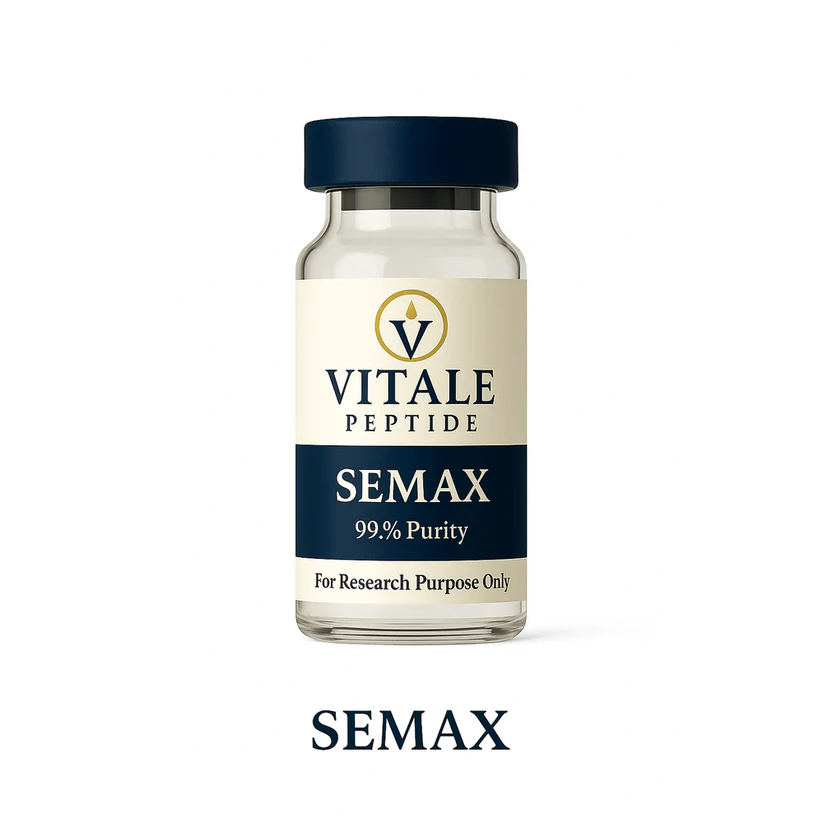
All products referenced in this article are intended strictly for laboratory and in-vitro research use. They are not for human consumption.
SEMAX is a synthetic peptide fragment derived from the adrenocorticotropic hormone (ACTH 4-10) sequence. It was developed to isolate a short amino acid chain from the larger ACTH molecule, removing hormonal activity while research has focused on the fragment’s relevance to neurological signaling pathways rather than adrenal function.
Because of this structural origin, SEMAX is frequently grouped alongside other short regulatory peptides studied for central nervous system pathways, distinguishing it from metabolic or growth-hormone-related compounds in the broader peptide research space.
SEMAX belongs to a class of peptides sometimes referred to in scientific literature as “heptapeptides” due to its seven-amino-acid structure. Its design reflects a broader trend in peptide research: isolating small, stable fragments of larger endogenous molecules to study specific biological pathways without the full hormonal cascade of the parent compound.
This approach is common across the research peptide field. For example, fragment-based research is also seen in compounds like BPC-157, a pentadecapeptide derived from a protective protein found in gastric juice, studied for tissue-related pathways in pre-clinical models.
A significant portion of SEMAX research has centered on cognitive processes in laboratory models, including learning acquisition and memory consolidation. Investigators have used SEMAX in behavioral and biochemical assays to examine how short peptide fragments interact with neural circuits associated with information processing.
One of the most frequently cited areas of SEMAX research involves its studied influence on BDNF expression. BDNF is a protein involved in neuron survival, growth, and synaptic plasticity, and pre-clinical studies have examined whether SEMAX administration correlates with changes in BDNF levels in specific brain regions. This line of inquiry connects SEMAX to a broader category of neurotrophic and cellular signaling research, similar in spirit to how MOTS-c is studied for mitochondrial-related cellular signaling, or how GHK-Cu is examined for its role in cellular repair pathways.
Neuroprotection research involving SEMAX has explored its potential relevance in models of oxidative stress and neuronal injury. Researchers have investigated whether the peptide’s presence correlates with measurable changes in markers of neuronal stability under experimental stress conditions.
SEMAX’s origin from ACTH — a hormone central to the body’s stress response axis — has led researchers to examine its relationship to stress-related signaling pathways, independent of the adrenal hormonal activity associated with full-length ACTH. This distinction is a key reason SEMAX is studied separately from adrenal or corticosteroid research models.
Within the broader catalog of research peptides, SEMAX is often studied alongside other compounds examined for central nervous system or cognitive-adjacent pathways. Selank, for instance, is another synthetic peptide studied in pre-clinical models for its relationship to anxiolytic-like behavioral markers and immune-neuro signaling. Researchers working across both compounds often use comparative study designs to differentiate their respective mechanisms.
Similarly, Kisspeptin research — while centered on reproductive endocrinology rather than cognition — reflects the same broader scientific interest in short regulatory peptides that influence signaling cascades at very low concentrations, a characteristic SEMAX also demonstrates in laboratory settings.
Peptide purity and batch consistency directly affect the reliability of research outcomes. Variability in synthesis, storage, or handling can introduce confounding variables into experimental data, which is why laboratories increasingly prioritize suppliers who can demonstrate rigorous quality controls.
At Vitale Peptide, every batch is sourced and handled according to strict quality standards to help ensure purity, identity, and consistency. This commitment allows researchers to focus on their experimental design rather than questioning the reliability of their materials — a principle that applies across our full catalog, from cognitive-research peptides like SEMAX to metabolic research compounds like Retatrutide and Tesamorelin.
What is SEMAX derived from? SEMAX is a synthetic fragment derived from the ACTH (4-10) amino acid sequence, isolated for research into neurological rather than adrenal pathways.
What has SEMAX research focused on? Pre-clinical research has explored SEMAX’s relationship to BDNF expression, cognitive function, neuroprotection, and stress-response signaling in laboratory models.
Is SEMAX approved for human use? No. SEMAX, like all products offered by Vitale Peptide, is intended strictly for laboratory research purposes and is not approved or intended for human consumption.
How is SEMAX typically studied alongside other peptides? Researchers often study SEMAX in comparative designs alongside other CNS-relevant peptides such as Selank, or use it in combination protocols examining broader neurotrophic and cellular pathways.
Vitale Peptide supplies a full catalog of research-grade compounds for laboratories and institutions, including:
Vitale Peptide provides premium research-grade SEMAX, manufactured and supplied with precision, consistency, and integrity for laboratory use.
All peptides sold by Vitale Peptide are for research purposes only and are not intended for human consumption, diagnostic, or therapeutic use.