
Researchers continue to study NAD+ for its central role in cellular energy production and metabolic regulation. This coenzyme exists in every living cell, so its research applications span an unusually wide range of biological systems. So, why does NAD+ draw so much attention across metabolic, neurological, and aging research? This article covers the science, the research pathways, and why sourcing quality plays such a large role in reliable lab results.
Buy Research-Grade NAD+ from Vitale Peptide →
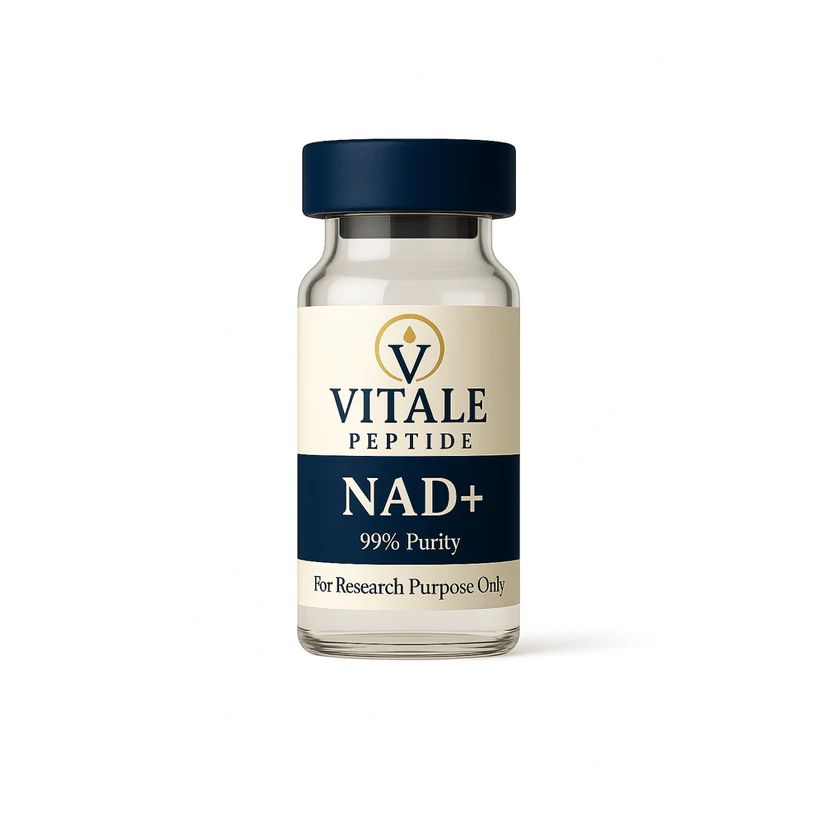
Vitale Peptide intends all products referenced in this article strictly for laboratory and in-vitro research use. None of them are intended for human consumption.
NAD+ stands for nicotinamide adenine dinucleotide, a coenzyme found in all living cells. It plays an essential role in cellular energy production, redox balance, and metabolic regulation. Nearly every cellular process that requires energy transfer depends on NAD+ in some capacity, which is why researchers consider it one of the most fundamental molecules in cell biology.
Because of this central role, NAD+ research spans multiple disciplines. Consequently, scientists study it in contexts ranging from mitochondrial biology to neuroscience and aging research.
NAD+ functions as a redox coenzyme, meaning it cycles between an oxidized form (NAD+) and a reduced form (NADH) during metabolic reactions. This cycling process allows cells to transfer electrons during energy production, and it directly supports processes like glycolysis and the citric acid cycle.
This biochemical role sets NAD+ apart from the synthetic signaling peptides more commonly discussed in laboratory research. For example, MOTS-c is a mitochondrial-derived peptide studied for its relationship to metabolic signaling, and researchers frequently examine it alongside NAD+ due to their shared connection to mitochondrial function.
Researchers frequently study NAD+ for its role in supporting mitochondrial function. Specifically, studies examine how NAD+ availability affects the mitochondria’s ability to generate cellular energy through oxidative phosphorylation.
A significant portion of NAD+ research centers on DNA repair mechanisms. Investigators study how NAD+ serves as a substrate for enzymes involved in repairing damaged DNA, particularly within the context of cellular stress and aging.
Pre-clinical research has explored NAD+ in the context of healthy aging. Because NAD+ levels naturally decline with age in laboratory models, researchers study whether restoring NAD+ availability correlates with improved markers of cellular function.
Scientists often explore NAD+ within the context of metabolic health, neuroprotection, and energy metabolism. As a result, researchers examine its relationship to metabolic regulation in some models and its potential relevance to neuronal stability in others.
Researchers often study NAD+ alongside other compounds examined for metabolic and cellular pathways. MOTS-c, for instance, is a mitochondrial-derived peptide studied for its relationship to metabolic signaling and energy regulation. Because both molecules connect closely to mitochondrial function, scientists sometimes use comparative study designs to differentiate their respective mechanisms.
Similarly, 5-Amino-1MQ research centers on metabolic regulation through a different biochemical pathway. Still, it reflects the same broader scientific interest in molecules that influence cellular energy and metabolic health, a category NAD+ also falls within.
Purity and batch consistency directly affect the reliability of research outcomes. Variability in synthesis, storage, or handling can introduce confounding variables into experimental data. As a result, laboratories increasingly prioritize suppliers who demonstrate rigorous quality controls.
At Vitale Peptide, we source and handle every batch according to strict quality standards. This helps ensure purity, identity, and consistency across the board. Ultimately, this commitment allows researchers to focus on experimental design rather than questioning material reliability. The same standard applies across our full catalog, from metabolic research compounds like NAD+ to cognitive-research peptides like SEMAX and Selank.

What is NAD+? NAD+ is a coenzyme found in all living cells. It plays an essential role in cellular energy production, redox balance, and metabolic regulation.
What has NAD+ research focused on? Pre-clinical research explores NAD+’s relationship to mitochondrial function, DNA repair, healthy aging, metabolic health, and neuroprotection in laboratory models.
Is NAD+ approved for human use? No. Vitale Peptide intends NAD+, like every product in our catalog, strictly for laboratory research. We do not approve or intend it for human consumption.
How do researchers typically study NAD+ alongside other compounds? Researchers often study NAD+ in comparative designs alongside other metabolic and mitochondrial-relevant compounds, such as MOTS-c. They also use it in combination protocols that examine broader cellular energy and aging pathways.
Vitale Peptide supplies a full catalog of research-grade compounds for laboratories and institutions, including:
Vitale Peptide manufactures and supplies premium research-grade NAD+ with precision, consistency, and integrity for laboratory use.
Vitale Peptide sells all products strictly for research purposes. We do not intend them for human consumption, diagnostic, or therapeutic use.