
The study of synthetic peptide analogs has expanded dramatically across biochemical and physiological fields.Among these, Melanotan II (MT-2) remains one of the most widely investigated compounds in melanocortin receptor research.Originally developed at the University of Arizona in the late 1980s, Melanotan II was engineered to mimic the activity of native $\alpha$-melanocyte-stimulating hormone ($\alpha$-MSH) while offering significantly enhanced stability and enzymatic resistance.
Today, researchers actively investigate Melanotan II to better understand cutaneous photoprotection, appetite regulation, central nervous system signaling, and cellular defense mechanisms.
Disclaimer: Melanotan II and all peptides mentioned on this site are supplied strictly for laboratory research purposes and in vitro scientific evaluation. They are not intended for human consumption or clinical use.
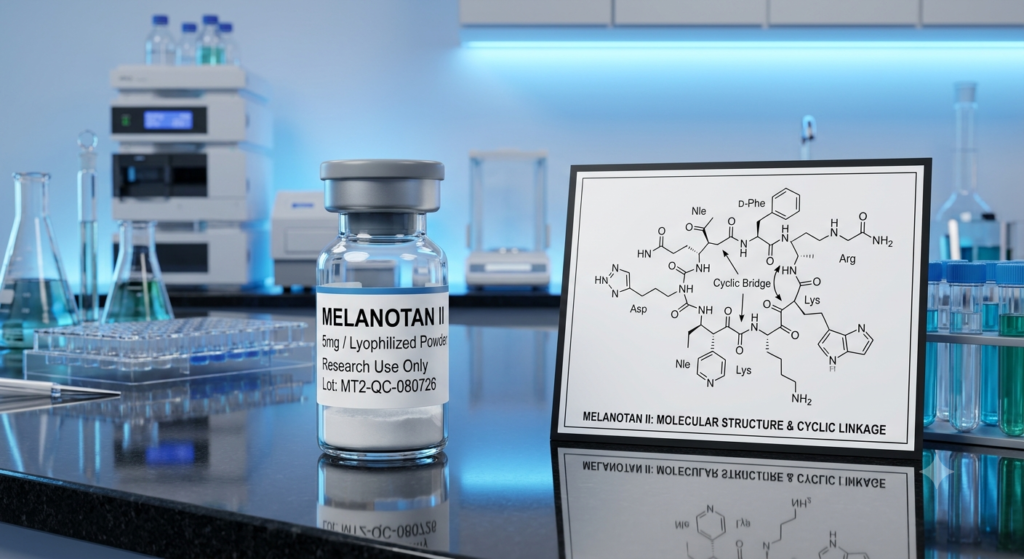
Melanotan II is a synthetic, cyclic heptapeptide analog of the naturally occurring peptide hormone $\alpha$-MSH. Native $\alpha$-MSH plays a central role in regulating skin pigmentation, energy homeostasis, inflammation, and autonomic signaling. However, natural endogenous $\alpha$-MSH has a very short half-life in biological systems because it breaks down rapidly via enzymatic cleavage.
To overcome this limitation, researchers created Melanotan II by modifying the sequence and introducing a cyclic lactam structure (specifically between aspartic acid and lysine residues).
Chemical Sequence: Ac-Nle-cyclo[Asp-His-D-Phe-Arg-Trp-Lys]-NH2
Molecular Formula: C50H69N15O9
CAS Number: 121062-08-6
These structural refinements yield two major properties in lab studies:
When reviewing cellular signaling, scientists often evaluate Melanotan II alongside metabolic research peptides like NAD+
and mitochondrial regulators like MOTS-c
to observe how energy pathways intersect.
To understand why Melanotan II is such a potent research compound, it helps to examine its structural chemistry.Native $\alpha$-MSH is a linear 13-amino-acid peptide. In contrast, Melanotan II is a truncated 7-amino-acid cyclic structure.
Due to these enhancements, researchers can study melanocortin activation in vitro without the rapid peptide degradation typical of linear molecules.
Melanocortin receptors (MCRs) belong to the G-protein coupled receptor (GPCR) superfamily. Five distinct melanocortin receptors have been identified ($MC1R$ through $MC5R$), each expressed in different tissues and regulating unique physiological pathways.
Melanotan II functions as a non-selective, high-affinity agonist across the melanocortin receptor family.
| Receptor Subtype | Primary Tissue Location | Key Research Focus Areas |
| MC1R | Melanocytes (Skin & Hair) | Melanogenesis, eumelanin synthesis, oxidative stress defense |
| MC2R | Adrenal Cortex | ACTH-mediated steroidogenesis (Minimal binding by MT-2) |
| MC3R | Hypothalamus, Heart, Energy Systems | Autonomic regulation, metabolic efficiency |
| MC4R | CNS, Hypothalamus | Appetite suppression, sexual arousal pathways, nerve repair |
| MC5R | Exocrine Glands, Skeletal Muscle | Sebaceous gland function, fatty acid oxidation |
For official biochemical data on human receptor classification and primary structures, consult the NCBI PubChem Compound Database
.
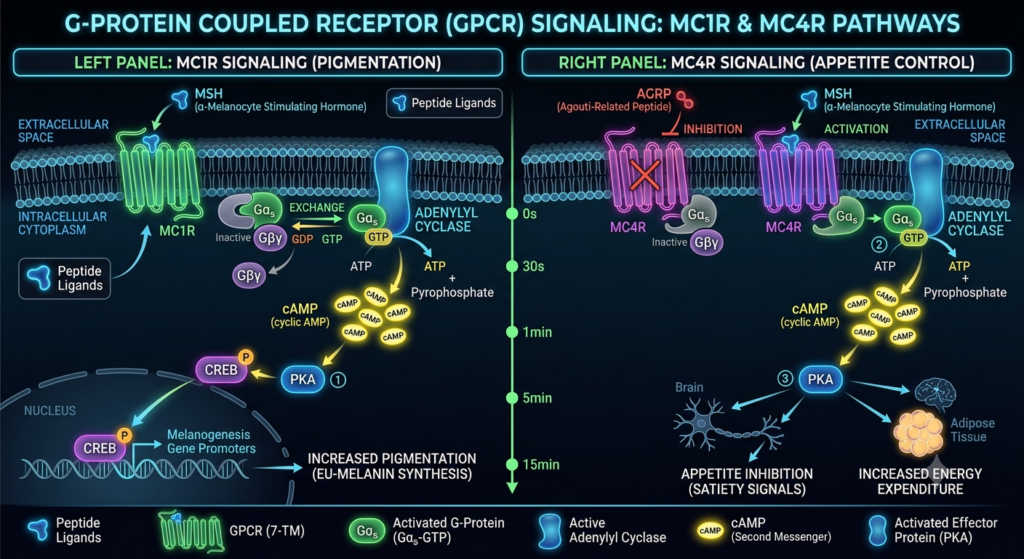
The primary focus of early Melanotan II studies centered on MC1R binding in skin epidermal cells.
When Melanotan II binds to MC1R on melanocytes:
Because eumelanin photoprotects dermal tissue against ultraviolet (UV) exposure, researchers utilize Melanotan II models to explore cellular mechanisms against phototoxicity and oxidative stress. In broader skin health research, researchers also analyze tissue remodeling using peptides like GHK-Cu
or recovery models involving BPC-157
Beyond cutaneous pathways, Melanotan II actively crosses or interacts with central nervous system boundaries. Its affinity for MC4R in the arcuate nucleus (Arc) and paraventricular nucleus (PVN) of the hypothalamus makes it a standard reference compound in metabolic studies.
This metabolic signaling makes MT-2 an intriguing subject when compared with modern metabolic researchers investigating GLP-3 5-Amino-1MQ or energy modulation compounds such as SLU-PP-332
Central MC3R and MC4R signaling pathways also intersect with autonomic pathways controlling reproductive reflexes. In preclinical trials, central melanocortin agonism by Melanotan II triggered downstream pro-erectile and sexual arousal signaling independent of vascular nitric oxide mechanisms.
These observations directly paved the way for subsequent research into sub-fragments and derivative molecules, such as Kisspeptin
, which explores complementary endocrine and reproductive axes.
Recent laboratory literature highlights potential neuroprotective properties mediated by MC4R.In neuronal cell cultures, melanocortin agonists have demonstrated the ability to promote neurite outgrowth, support nerve regeneration following chemical toxicity, and reduce neuroinflammatory cascades. Researchers frequently contrast these neurological models against neuro-active peptides like Selank
To better understand how Melanotan II operates in laboratory settings, researchers often contrast its dual-action melanocortin profile with other targeted research compounds:
| Feature / Objective | Melanotan II | BPC-157 / TB-500 Blend | CJC-1295 / Ipamorelin |
| Primary Receptors | MC1R, MC3R, MC4R, MC5R | Angiogenic / Growth Factor pathways | GHSR / GHRH Receptors |
| Primary System Targeted | Melanogenesis & Central Nervous System | Connective Tissue & Cytoprotection | Pituitary Somatotroph Axis |
| Primary Outcome Measure | Pigmentation, Appetite, cAMP activity | Collagen synthesis & Cell Migration | Growth Hormone Release Pulse |

Maintaining peptide integrity is essential for reproducible experimental results. Melanotan II is typically supplied as a lyophilized (freeze-dried) powder to maintain structural stability during storage.
To review peer-reviewed experimental protocols regarding synthetic melanocortins, visit the PubMed Central Literature Database
Melanotan II remains an essential pharmacological tool for investigating melanocortin receptor activation, cutaneous photoprotection, appetite pathways, and central neuro-signaling.Its non-selective binding affinity allows scientists to examine multi-system responses in unified biological models.
Explore our full catalog of research-grade compounds at Vitale Peptide
to support your laboratory’s experimental objectives.
Melanotan II targets the melanocortin receptor family ($MC1R$–$MC5R$).Its strongest effects in skin research are mediated by $MC1R$ (pigmentation/melanogenesis) and in neurological/metabolic research by $MC4R$ (appetite and autonomic reflexes).
While natural $\alpha$-MSH is a linear peptide with a very short biological half-life, Melanotan II is a cyclic heptapeptide designed with structural modifications (including D-Phe substitution and cyclization).These changes make MT-2 significantly more stable against enzymatic breakdown.
No. All products offered, including Melanotan II, are explicitly intended for laboratory research and scientific evaluation only. They are not cleared or intended for human consumption, therapeutic use, or clinical administration.