
In neuroendocrinology and reproductive physiology, few peptide discoveries have transformed scientific understanding as dramatically as Kisspeptin. Known as the primary “master switch” of the human reproductive axis, Kisspeptin plays an essential role in triggering pubertal development, regulating fertility pathways, and controlling luteinizing hormone (LH) and follicle-stimulating hormone (FSH) secretion.
Derived from the KISS1 gene, Kisspeptin acts directly on the KISS1 receptor (formerly known as GPR54) within the hypothalamus. Because it operates at the top of the Hypothalamic-Pituitary-Gonadal (HPG) axis, Kisspeptin has become a major focus of laboratory studies exploring endocrine signaling, fertility disorders, and hormone regulation.
Whether you are evaluating neuroendocrine feedback loops or studying pulse dynamics in reproductive biology, understanding how Kisspeptin triggers Gonadotropin-Releasing Hormone (GnRH) is fundamental to modern endocrine research.
Research Supply Notice: High-purity, laboratory-grade Kisspeptin is available for scientific experimentation. Researchers can Buy Kisspeptin Peptide online directly from Vitale Peptide.
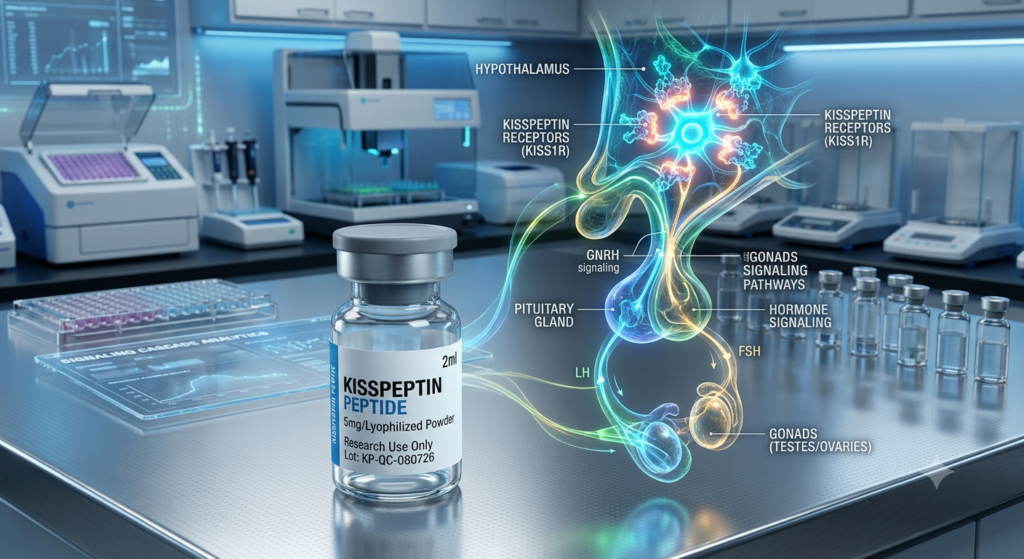
Kisspeptin is a naturally occurring family of neuroendocrine peptides encoded by the KISS1 gene in humans. The primary precursor protein is cleaved into shorter biologically active fragments, with Kisspeptin-10 (a 10-amino-acid C-terminal sequence) being the most widely utilized form in laboratory settings due to its high affinity for the KISS1 receptor.
Key Structural & Biochemical Specifications:
• Receptor Subtype: KISS1 Receptor (GPR54 / AXOR12)
• Primary Site of Action: Arcuate Nucleus (ARC) & Anteroventral Periventricular Nucleus (AVPV)
• Primary Function: Pulsatile GnRH Secretion Trigger
• Downstream Hormones: Luteinizing Hormone (LH) & Follicle-Stimulating Hormone (FSH)
• Research Focus: Reproductive Endocrinology, Puberty Onset, Fertility Pathways
Before the discovery of Kisspeptin’s role in the early 2000s, scientists knew that GnRH controlled the release of reproductive hormones, but the upstream trigger remained unknown. Today, Kisspeptin is recognized as the essential physiological bridge between metabolic status, environmental cues, and central reproductive function.
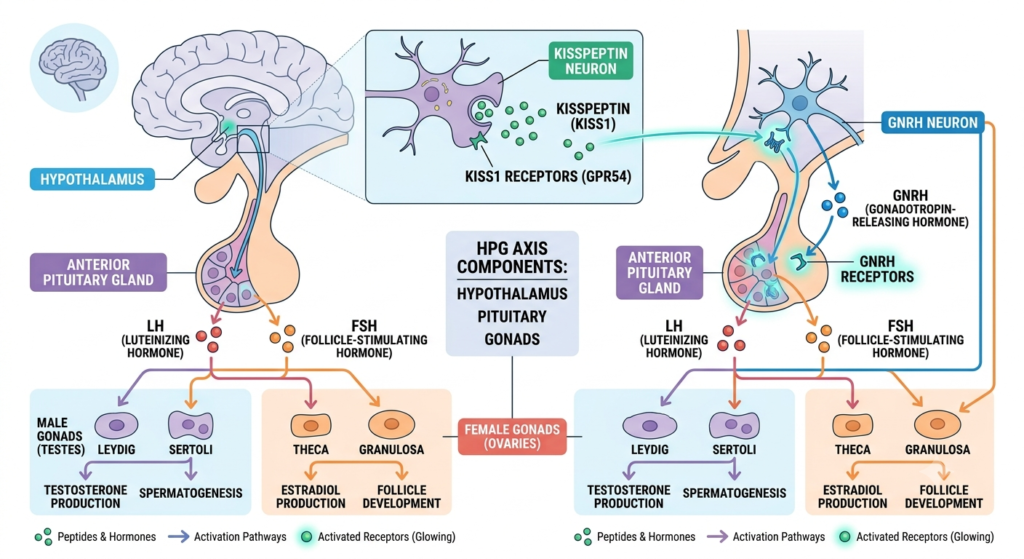
To understand why Kisspeptin is so vital in laboratory research, it is helpful to examine its step-by-step signaling pathway through the HPG axis.
[Kisspeptin Release] ➔ [Binds KISS1R (GPR54)] ➔ [Stimulates GnRH Neurons] ➔ [Pituitary Releases LH & FSH] ➔ [Gonadal Sex Steroid Production]
Kisspeptin functions as an endogenous ligand for the KISS1 receptor (GPR54), a G-protein coupled receptor expressed heavily on GnRH neurons in the hypothalamus.
When Kisspeptin binds to GPR54:
Unlike other neuropeptides that cause gradual hormonal shifts, Kisspeptin induces rapid, high-amplitude pulses of Gonadotropin-Releasing Hormone (GnRH) into the hypophyseal portal system.
Once GnRH reaches the anterior pituitary gland:
Due to its central position in hormone regulation, Kisspeptin is widely researched across multiple biological fields:
Kisspeptin is heavily investigated as a potential therapeutic target for reproductive disorders. In preclinical models of hypogonadotropic hypogonadism, Kisspeptin administration restores LH pulses and reactivates dormant reproductive pathways without desensitizing pituitary receptors as rapidly as continuous GnRH analogs.
Reproduction requires significant energy. When biological systems face caloric restriction or severe metabolic stress, fertility is downregulated. Research demonstrates that Kisspeptin neurons in the arcuate nucleus act as metabolic sensors:
Because of this link, Kisspeptin is frequently studied alongside metabolic research peptides such as GLP-3, 5-Amino-1MQ, and mitochondrial enhancers like MOTS-c.
Beyond the hypothalamus, KISS1 receptors are expressed in the limbic system, including the amygdala and hippocampus. Preclinical trials indicate that Kisspeptin signaling modulates emotional processing, fear responses, and sexual behavior. Researchers often cross-evaluate these neuro-behavioral effects against central peptides like Selank.
Researchers often stack or compare Kisspeptin with other peptide categories to observe cross-system interactions in laboratory models:
| Peptide Category | Example Compounds | Research Focus Comparison |
| Neuroendocrine / HPG | Kisspeptin | Direct upstream regulator of GnRH, LH, and FSH |
| Pituitary GH Secretagogues | Ipamorelin, Sermorelin, CJC-1295 No DAC, TESA | Targets somatotroph cells to stimulate Growth Hormone (GH) release |
| Systemic Tissue Repair | BPC-157, TB-500, KLOW Blend | Accelerates collagen synthesis, angiogenesis, and cell migration |
| Cosmetic & Dermal Matrix | GHK-Cu, GLOW Blend | Upregulates collagen Type I/III and extracellular matrix remodeling |
| Energy & Cellular Longevity | NAD+, SLU-PP-332 | Enhances mitochondrial function, fatty acid oxidation, and ATP production |
Looking for Research-Grade Compounds? Explore the full catalog at Vitale Peptide for certified laboratory reagents.
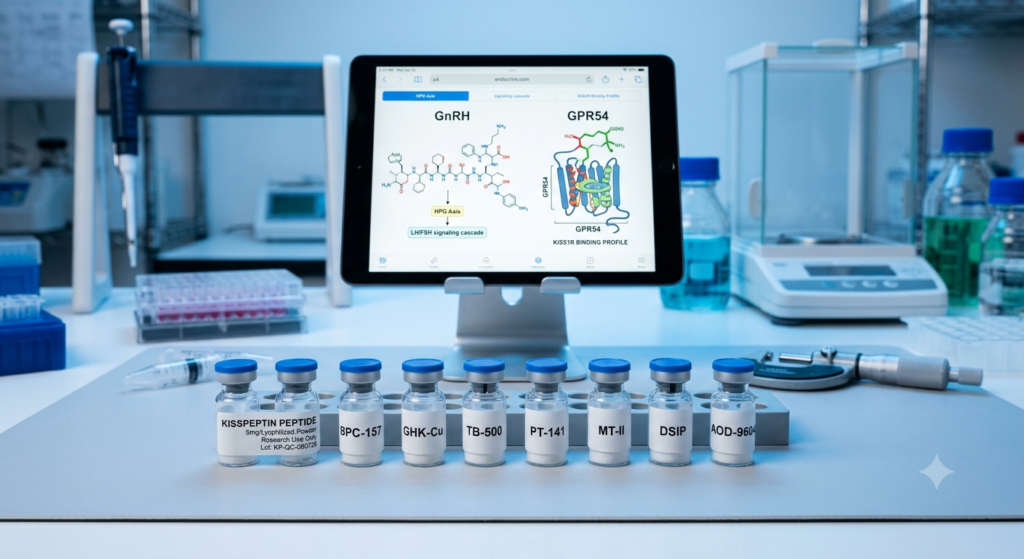
To ensure reproducible experimental results, proper peptide handling is mandatory:
For additional peer-reviewed scientific studies on KISS1 receptor pathways, consult the NCBI PubChem Database
or the PubMed Literature Repository.
When purchasing Kisspeptin for laboratory research, source quality and sequence purity are essential for valid experimental outcomes. Vitale Peptide provides research-grade Kisspeptin manufactured under strict analytical controls.
Advance your neuroendocrine research today—Buy Kisspeptin Peptide from Vitale Peptide.
All products sold on VitalePeptide.com, including Kisspeptin, are intended strictly for laboratory research, in vitro experimentation, and scientific evaluation. They are not intended for human consumption, clinical use, or therapeutic administration.
Kisspeptin is primarily studied as the master trigger for Gonadotropin-Releasing Hormone (GnRH) release in the hypothalamus, making it a critical peptide for investigating the Hypothalamic-Pituitary-Gonadal (HPG) axis, puberty onset, and fertility signaling.
Kisspeptin binds to the KISS1 receptor (GPR54) on GnRH neurons in the brain. This binding stimulates a rapid release of GnRH, which signals the pituitary gland to release Luteinizing Hormone (LH) and Follicle-Stimulating Hormone (FSH).
Kisspeptin regulates reproductive hormones (LH, FSH, and sex steroids) through the HPG axis. In contrast, Growth Hormone secretagogues like Ipamorelin
or Sermorelin
target the pituitary somatotrophs to regulate Growth Hormone (GH) secretion.
You can order high-purity, laboratory-grade Kisspeptin online at Vitale Peptide
for all your scientific research needs.