
In cellular biology and regenerative medicine research, multi-peptide formulations have become the gold standard for studying complex tissue repair and inflammation pathways. Single-peptide studies provide valuable baseline data, but synergistic peptide blends allow scientists to examine how multiple molecular cascades interact simultaneously.
Among modern regenerative blends, KLOW Peptide stands out as one of the most comprehensive scientific research formulations available. Combining four powerful compounds—BPC-157, GHK-Cu, TB-500, and KPV—in exact biochemical ratios, KLOW is engineered to support laboratory investigation into cellular protection, collagen cross-linking, cell migration, and anti-inflammatory signaling.
Whether you are designing in vitro tissue models or evaluating peptide dynamics, understanding the individual and combined mechanics of KLOW is key to maximizing research outcomes.
Research Order Notice: High-purity, laboratory-grade KLOW Peptide is available for scientific study. Researchers looking to procure certified reagents can Buy KLOW Peptide (80mg Blend) directly from Vitale Peptide.
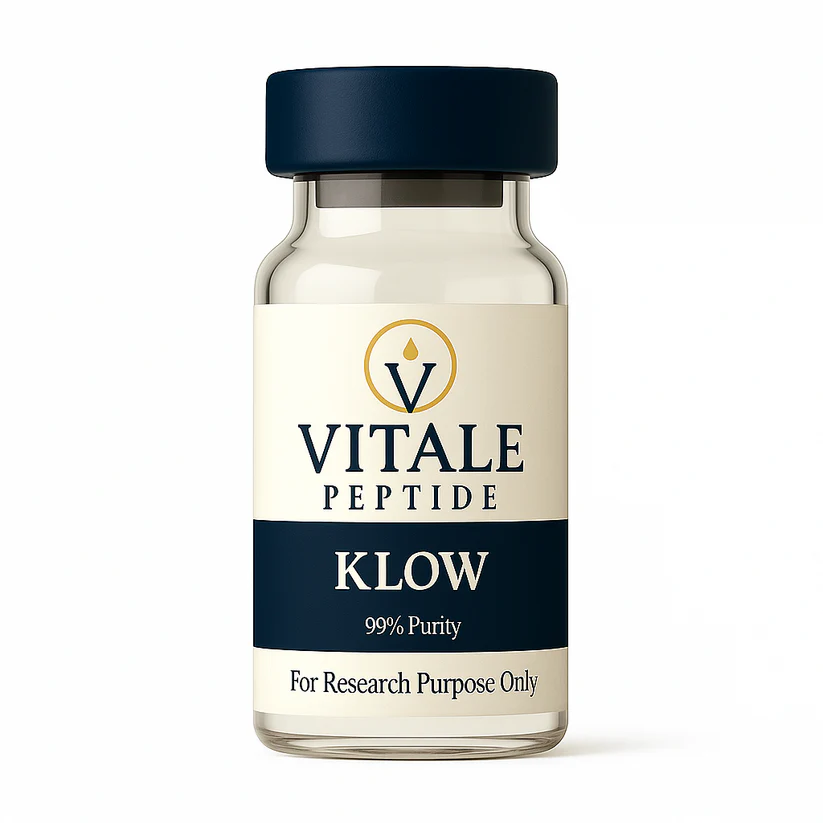
KLOW Peptide is a high-purity, multi-component research peptide formulation containing 80 mg total active sequence per vial. Unlike standard single-peptide preparations, KLOW integrates four distinct peptide mechanisms that target different stages of the cellular repair and recovery process.
Total Active Content per Vial: 80 mg
Formulation Composition:
• BPC-157: 10 mg
• GHK-Cu: 50 mg
• TB-500 (Thymosin Beta-4 Derivative): 10 mg
• KPV (alpha-MSH C-terminal tripeptide): 10 mg
Purity Grade: High-Purity Lyophilized Powder
Primary Focus: Tissue Regeneration, Collagen Synthesis, Cell Migration, Inflammation Control
By unifying these four research compounds into a single vial, scientists can eliminate variable compounding errors during laboratory testing while observing how micro-environmental healing pathways collaborate.
To appreciate why the KLOW blend is so effective in experimental models, let us examine the specific molecular mechanics of each peptide in the formula.
Body Protection Compound 157 (BPC-157) is a pentadecapeptide derived from human gastric juice proteins. In biochemical research, BPC-157 is widely studied for its cytoprotective and tissue-healing capabilities.
Researchers interested in standalone gastrointestinal or soft-tissue repair models can also study the BPC-157 10mg standalone compound
GHK-Cu (Glycyl-L-histidyl-L-lysine copper) is a naturally occurring tripeptide-copper complex found in human plasma. It serves as a primary signal for tissue remodeling, skin elasticity, and extracellular matrix (ECM) restoration.
Due to its potent skin and matrix remodeling profile, GHK-Cu is often evaluated in cosmetic science alongside aesthetic blends like GLOW Peptide
or standalone GHK-Cu 50mg
TB-500 is a synthetic fragment of the naturally occurring protein Thymosin Beta-4. Its primary biological role revolves around actin sequestration and cell movement.
For dual-action recovery studies, scientists frequently compare KLOW with the targeted BPC-157 / TB-500 Blend
or standalone TB-500
KPV (Lysine-Proline-Valine) is a C-terminal tripeptide fragment of $\alpha$-melanocyte-stimulating hormone ($\alpha$-MSH). Despite its small size, KPV exerts potent anti-inflammatory properties without triggering pigmentation pathways.
While compounds like Melanotan II
target melanocyte pigmentation via $MC1R$, KPV isolates the anti-inflammatory spectrum of melanocortin signaling, making it ideal for inflammatory research.
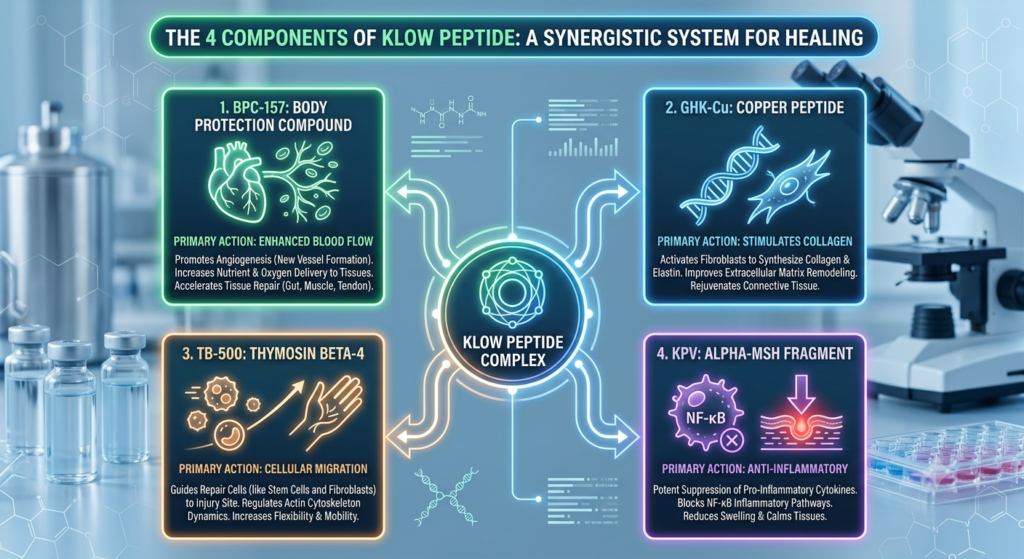
When evaluating tissue repair, relying on a single mechanism often yields limited insights. Regeneration is a multi-step biological event requiring:
| Research Objective | Single Peptide Limitation | KLOW Blend Synergy |
| Tissue Repair | BPC-157 supports blood vessels but lacks matrix density signaling | BPC-157 builds vascular pathways while GHK-Cu deposits structural collagen |
| Inflammation Control | Standard anti-inflammatory agents do not accelerate healing | KPV blocks NF-$\kappa$B while TB-500 mobilizes repairing cells into position |
| Recovery Speed | Single mechanisms work sequentially | Four simultaneous pathways shorten the research timeline in experimental models |
This multi-faceted mechanism makes KLOW one of the most versatile research tools available for cellular biology.
Need Research Supplies? Ensure your laboratory tests utilize verified, high-purity peptides. Order KLOW Peptide 80mg from Vitale Peptide.
Researchers across molecular biology, dermatology, and sports science utilize KLOW in several core experimental domains:
Tendons, ligaments, and cartilage have limited vascular supply, making them slow to recover in biological models. In vitro studies combining BPC-157 and TB-500 have demonstrated accelerated fibroblast growth and faster alignment of collagen fibers.
The combination of GHK-Cu and KPV makes KLOW exceptionally well-suited for skin tissue regeneration studies. GHK-Cu encourages collagen production while KPV suppresses excessive inflammatory responses, reducing hypertrophic scarring in wound models.
Both BPC-157 and KPV exhibit strong mucosal protective properties. In gastrointestinal tissue models, these peptides help preserve tight junction proteins (Claudins and Occludins), protecting intestinal epithelia from inflammatory degradation.
Researchers evaluating recovery protocols often combine regenerative peptides like KLOW with metabolic and mitochondrial research compounds such as NAD+, MOTS-c, or 5-Amino-1MQ
to evaluate how tissue repair intersects with cellular energy levels.

To help select the right reagents for your specific laboratory protocol, here is how KLOW compares to other formulations in the Vitale Peptide Catalog:
KLOW vs. BPC-157 / TB-500 Blend:
• BPC-157 / TB-500: Focuses strictly on vascular support, cell mobility, and soft tissue repair.
• KLOW: Adds GHK-Cu (collagen deposition) and KPV (NF-kB anti-inflammatory control) for comprehensive 4-way repair.

KLOW vs. GLOW Peptide:
• GLOW: Formulated primarily for cosmetic/dermal remodeling and skin radiance research.
• KLOW: Engineered as a heavy-duty recovery blend targeting deep tissues, joints, gut mucosa, and systemic inflammation.

KLOW vs. Secretagogue Growth Factors:
• Growth Hormone Secretagogues like CJC-1295 / Ipamorelin or Sermorelin target the pituitary-somatotroph axis to increase systemic GH release.
• KLOW acts directly at the localized cellular and extracellular matrix level to drive structural repair.Maintaining peptide stability is critical to ensuring valid, reproducible experimental data. Follow these standard handling protocols when working with KLOW Peptide:
For technical literature on peptide synthesis and purity verification, refer to the NCBI PubChem Compound Database
When purchasing research peptides online, purity, consistency, and chemical verification are essential. Vitale Peptide supplies premium, high-purity research compounds manufactured under strict quality-control protocols.
Ready to advance your tissue repair research? Buy KLOW Peptide (80mg Blend) from Vitale Peptide today and secure high-purity reagents for your laboratory experiments.
All products sold on VitalePeptide.com, including KLOW Peptide, are intended strictly for laboratory research, in vitro experimentation, and scientific evaluation. They are not intended for human consumption, clinical use, or therapeutic administration.
KLOW Peptide is designed for laboratory research into tissue repair, wound healing, collagen cross-linking, cell migration, and anti-inflammatory pathways. Its 4-in-1 blend allows researchers to evaluate multiple regenerative mechanisms simultaneously.
Each vial contains BPC-157 (10mg), GHK-Cu (50mg), TB-500 (10mg), and KPV (10mg), totaling 80mg of active research compound per vial.
While single peptides target specific mechanisms (e.g., BPC-157 for blood flow or GHK-Cu for collagen), KLOW combines four distinct pathways—angiogenesis, cell mobility, extracellular matrix rebuilding, and NF-$\kappa$B inflammation suppression—into a single formula.
After reconstituting with sterile or bacteriostatic water, store the solution in a refrigerator at $2^\circ\text{C}$ to $8^\circ\text{C}$ ($36^\circ\text{F}$ to $46^\circ\text{F}$) and protect it from direct light.
You can buy certified, high-purity KLOW Peptide directly from Vitale Peptide
for laboratory and scientific research.