
Researchers continue to study MOTS-c peptide for its role in cellular energy regulation and metabolic balance. Scientists derive this mitochondrial peptide from the mitochondrial genome itself, so it occupies a unique position in metabolic research. So, why has MOTS-c become such a focal point in mitochondrial and metabolic studies? This article covers the science, the research pathways, and why sourcing quality plays such a large role in reliable lab results.
Buy Research-Grade MOTS-c from Vitale Peptide →
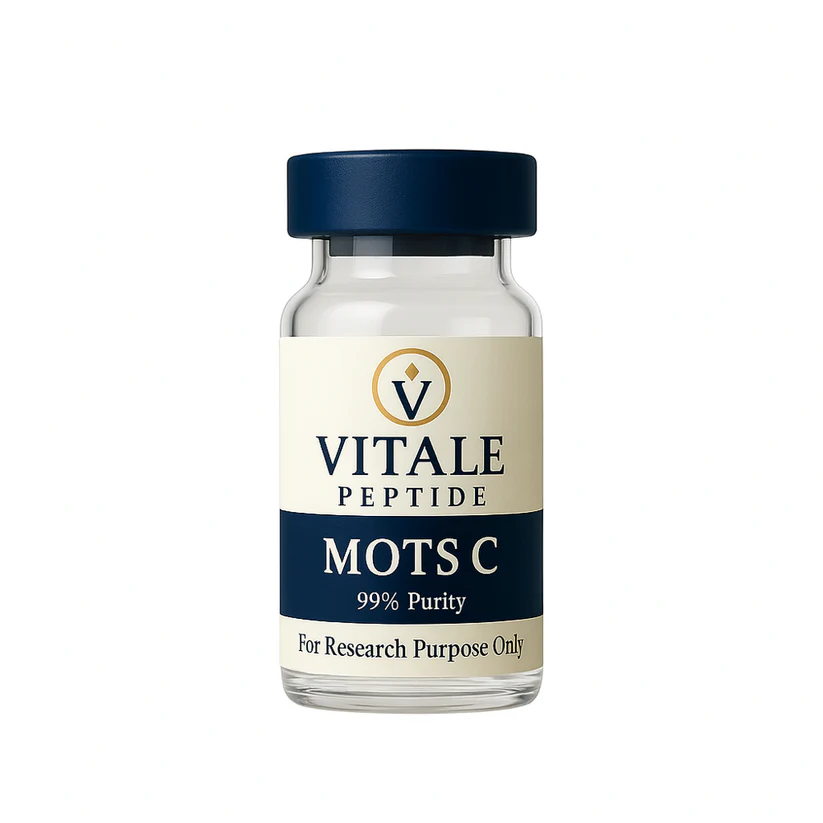
Vitale Peptide intends all products referenced in this article strictly for laboratory and in-vitro research use. None of them are intended for human consumption.
MOTS-c is a mitochondrial-derived research peptide. Unlike most peptides, which originate from nuclear DNA, researchers trace MOTS-c back to the mitochondrial genome. This origin places it within a small but growing class of molecules known as mitochondrial-derived peptides, and it directly informs why scientists study MOTS-c in the context of cellular energy regulation.
Because of this mitochondrial origin, researchers view MOTS-c as a potential signaling link between mitochondrial activity and broader metabolic processes. Consequently, studies increasingly examine how the peptide participates in metabolic balance and cellular stress response.
MOTS-c consists of a short amino acid sequence encoded within the mitochondrial 12S rRNA region. This genetic origin sets it apart from peptides derived from conventional protein-coding genes, and it also explains why researchers classify MOTS-c as a distinct signaling molecule rather than a structural protein fragment.
This mitochondrial connection places MOTS-c in a research category alongside other molecules tied to cellular energy metabolism. For example, NAD+ plays an essential role in the same mitochondrial energy pathways that MOTS-c research explores, which is why scientists frequently study the two together.
Researchers frequently study MOTS-c for its potential role in cellular energy regulation. Specifically, studies examine how the peptide influences energy utilization within laboratory models, particularly under conditions of metabolic stress.
A significant portion of MOTS-c research centers on AMPK activation. AMPK, or AMP-activated protein kinase, functions as a key cellular energy sensor. Because AMPK activation influences multiple downstream metabolic pathways, researchers investigate MOTS-c’s relationship to this activation process in considerable detail.
Pre-clinical research has explored MOTS-c’s possible involvement in pathways that support metabolic homeostasis. As a result, researchers examine whether the peptide correlates with improved markers of metabolic balance across various experimental models.
Scientists also study MOTS-c for its potential involvement in cellular stress response pathways. This research often overlaps with metabolic signaling studies, since stress response and metabolic regulation frequently intersect at the cellular level.
Researchers often study MOTS-c alongside other compounds examined for metabolic and cellular pathways. NAD+, for instance, is a coenzyme studied for its role in mitochondrial function and cellular energy production. Because both molecules connect closely to mitochondrial activity, scientists sometimes use comparative study designs to differentiate their respective mechanisms.
Similarly, 5-Amino-1MQ research centers on metabolic regulation through a different biochemical pathway. Still, it reflects the same broader scientific interest in molecules that influence cellular energy and metabolic health, a category MOTS-c also falls within. Researchers also examine SLU-PP-332 within this same metabolic research space, since it targets pathways related to energy expenditure.
Peptide purity and batch consistency directly affect the reliability of research outcomes. Variability in synthesis, storage, or handling can introduce confounding variables into experimental data. As a result, laboratories increasingly prioritize suppliers who demonstrate rigorous quality controls.
At Vitale Peptide, we source and handle every batch according to strict quality standards. This helps ensure purity, identity, and consistency across the board. Ultimately, this commitment allows researchers to focus on experimental design rather than questioning material reliability. The same standard applies across our full catalog, from metabolic research peptides like MOTS-c to cognitive-research peptides like SEMAX and Selank.
[IMAGE 4 — QUALITY CONTROL VISUAL] Suggested placement: after the sourcing/quality section. ChatGPT image prompt: “A professional laboratory scene showing several small glass research vials arranged neatly on a white countertop, next to a clipboard with a checklist, soft natural lighting, clean and trustworthy scientific aesthetic, no visible faces or brand logos.”
What is MOTS-c derived from? MOTS-c is a mitochondrial-derived peptide. Researchers trace its origin to a short sequence encoded within the mitochondrial 12S rRNA region.
What has MOTS-c research focused on? Pre-clinical research explores MOTS-c’s relationship to cellular energy regulation, AMPK activation, metabolic homeostasis, and cellular stress response in laboratory models.
Is MOTS-c approved for human use? No. Vitale Peptide intends MOTS-c, like every product in our catalog, strictly for laboratory research. We do not approve or intend it for human consumption.
How do researchers typically study MOTS-c alongside other compounds? Researchers often study MOTS-c in comparative designs alongside other metabolic and mitochondrial-relevant compounds, such as NAD+. They also use it in combination protocols that examine broader energy metabolism and stress-response pathways.
Vitale Peptide supplies a full catalog of research-grade compounds for laboratories and institutions, including:
Vitale Peptide manufactures and supplies premium research-grade MOTS-c with precision, consistency, and integrity for laboratory use.
Vitale Peptide sells all products strictly for research purposes. We do not intend them for human consumption, diagnostic, or therapeutic use.