
Research Use Only. This article and the products referenced are intended strictly for laboratory and research purposes. Nothing here constitutes medical advice, and no compound discussed is intended for human or animal consumption.
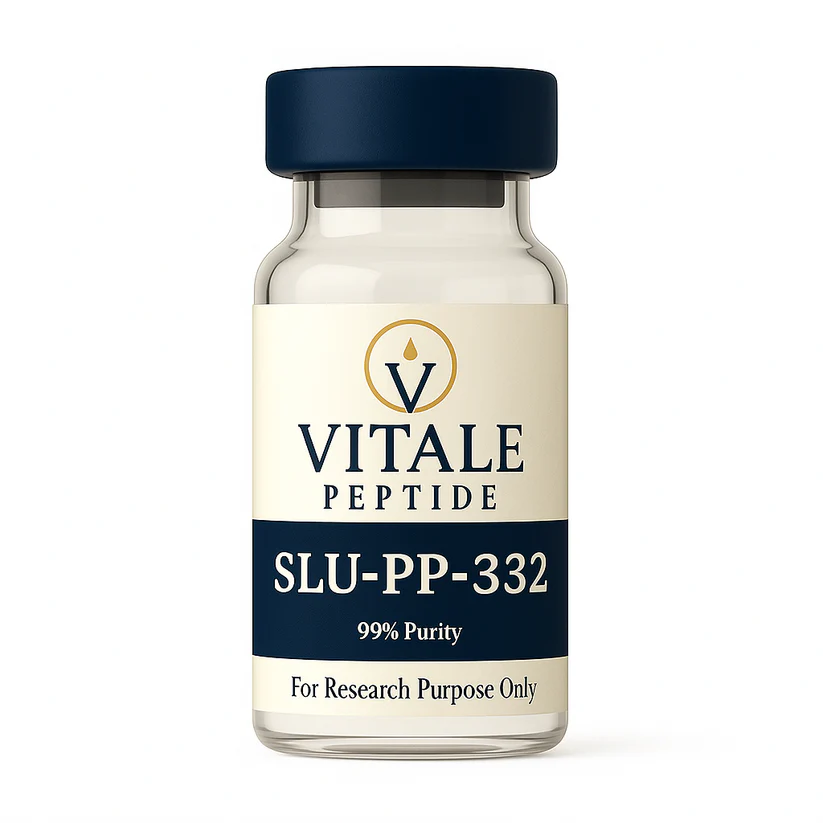
SLU-PP-332 has become one of the more closely watched compounds in metabolic and mitochondrial research, largely because it reproduces gene-expression patterns associated with aerobic exercise in preclinical models. In this guide, we explain what SLU-PP-332 actually is, correct a common mechanism misconception, walk through how its receptor activity works, and summarize what current published research shows. Additionally, we’ll cover sourcing, storage, and the compound’s current regulatory status, since all three matter for research planning. Whether you’re a lab researcher, a procurement officer, or simply researching the terminology, this guide draws on current peer-reviewed literature and manufacturer documentation.
Vitale Peptide supplies research-grade SLU-PP-332 to laboratories and institutions that need dependable, verified compounds for controlled studies. Before evaluating a supplier or designing a study protocol, it helps to understand exactly what this compound is and which receptor pathway it actually engages.
SLU-PP-332 is a synthetic small-molecule research compound developed at Saint Louis University School of Medicine, first characterized in a 2023 publication in ACS Chemical Biology. Despite sometimes being grouped alongside peptide products, SLU-PP-332 is not a peptide — it is a small-molecule ligand for nuclear transcription factors, and researchers should treat it as structurally distinct from peptide-based compounds in the same catalog.
The compound was designed as a pharmacological research tool for studying estrogen-related receptor (ERR) biology, a receptor family that regulates mitochondrial biogenesis, oxidative phosphorylation, and fatty acid metabolism. Because SLU-PP-332 reproduces many of the transcriptional changes associated with aerobic exercise in preclinical models, the research literature frequently describes it as an “exercise mimetic” compound. SLU-PP-332 has not been studied in humans and is not approved by the FDA, EMA, or any other regulatory authority for any indication. Vitale Peptide supplies SLU-PP-332 exclusively for in-vitro and preclinical research applications — not for human or animal administration.
Some product descriptions and secondary sources describe SLU-PP-332 as a PPARδ activator. This is inaccurate. Published research from the compound’s original characterization identifies SLU-PP-332 as a pan-agonist of the estrogen-related receptor (ERR) family — specifically ERRα, ERRβ, and ERRγ — not the PPAR (peroxisome proliferator-activated receptor) family. While both receptor families influence metabolic gene expression, they are structurally and functionally distinct nuclear receptor classes. Researchers designing studies around SLU-PP-332 should reference the ERR pathway specifically, since receptor misidentification can lead to selecting the wrong assay controls or comparator compounds.
SLU-PP-332’s research value centers on its interaction with the estrogen-related receptor family.
SLU-PP-332 binds a hydrophobic pocket adjacent to the ligand-binding domain of ERR receptors, stabilizing the receptor’s active conformation. This is notable because ERRs are orphan nuclear receptors with no known natural ligand, which makes a synthetic tool compound like SLU-PP-332 particularly valuable for studying their transcriptional activity.
Once SLU-PP-332 stabilizes the active receptor conformation, it promotes recruitment of transcriptional coactivators — most notably PGC-1α (peroxisome proliferator-activated receptor gamma coactivator 1-alpha), a master regulator of mitochondrial biogenesis that itself lacks direct DNA-binding capacity but amplifies ERR-driven gene transcription.
Through this receptor-coactivator interaction, SLU-PP-332 drives transcription of genes governing mitochondrial biogenesis, fatty acid oxidation, and oxidative phosphorylation, primarily studied in skeletal muscle, cardiac, and liver tissue models.
Consequently, researchers frame SLU-PP-332 as a transcriptional-pathway tool rather than a direct metabolic intervention — a distinction that shapes how comparator and control groups are typically designed.
SLU-PP-332 sits on a growing but entirely preclinical body of research. Key points researchers should understand:
Because the “exercise mimetic” framing describes overlapping gene-expression signatures rather than a clinically validated equivalence to exercise, researchers should treat this terminology as a mechanistic description, not a demonstrated outcome claim.
Laboratories and institutions studying SLU-PP-332 typically investigate one or more of the following areas:
Since all of these applications require a compound with verified purity and consistent batch characteristics, sourcing quality matters just as much as the research question itself.
Researchers should be aware of SLU-PP-332’s current regulatory classification. The compound is not approved by the FDA, EMA, or any other regulatory authority for any indication, and it is not currently in active regulatory development as a drug candidate. It has also been classified by the World Anti-Doping Agency as a prohibited substance under the metabolic-modulator category in sports contexts. Neither classification affects its legitimate use as a laboratory research compound, but researchers should factor this regulatory context into institutional compliance documentation when designing studies.
Research integrity depends on knowing exactly what’s in the vial. Therefore, when evaluating a supplier for SLU-PP-332 or any research compound, look for:
Vitale Peptide includes this documentation with every batch of SLU-PP-332 we supply, so researchers can reference it directly in their own quality-control processes.
Compound stability depends on temperature, light, and moisture control, so proper handling protocols directly affect research validity:
Does SLU-PP-332 target PPARδ or ERR receptors? SLU-PP-332 targets the estrogen-related receptor (ERR) family — specifically ERRα, ERRβ, and ERRγ — not PPARδ. Some secondary sources describe it as a PPARδ activator, but this doesn’t match its published mechanism of action.
Is SLU-PP-332 a peptide? No. SLU-PP-332 is a small-molecule compound, not a peptide, even though it’s sometimes listed alongside peptide products in research catalogs.
What does “exercise mimetic” mean in this context? It’s a research term describing how SLU-PP-332 reproduces certain gene-expression changes seen with aerobic exercise in preclinical models — it does not imply a demonstrated clinical substitute for exercise.
Has SLU-PP-332 been tested in humans? No. Current published research is limited to in vitro assays and mouse models; SLU-PP-332 has not been evaluated in human clinical trials.
How should researchers store SLU-PP-332? Researchers should store the compound in a cool, dry place away from light and follow the supplier’s specific documentation for reconstituted or in-solution storage.
Does Vitale Peptide provide documentation for research compliance? Yes. Every batch includes a Certificate of Analysis (COA) confirming purity and identity, which researchers can reference for their own quality-control records.
SLU-PP-332 offers researchers a well-characterized pharmacological tool for studying ERR receptor biology and its downstream role in mitochondrial biogenesis and energy metabolism. Its “exercise mimetic” research profile has generated significant interest, but the evidence base remains entirely preclinical, built on in vitro and mouse model data rather than human trials. As with any research compound, sourcing from a supplier that provides verified purity documentation remains essential to reliable, reproducible results.
Looking for research-grade SLU-PP-332 with full batch documentation? Browse our SLU-PP-332 research compound listing or contact our team to request a Certificate of Analysis before you order.
Research Use Only. Not for human or animal consumption. This article is intended for informational and research-context purposes only.