
Research Use Only. This article and the products referenced are intended strictly for laboratory and research purposes. Nothing here constitutes medical advice, and no compound discussed is intended for human or animal consumption.
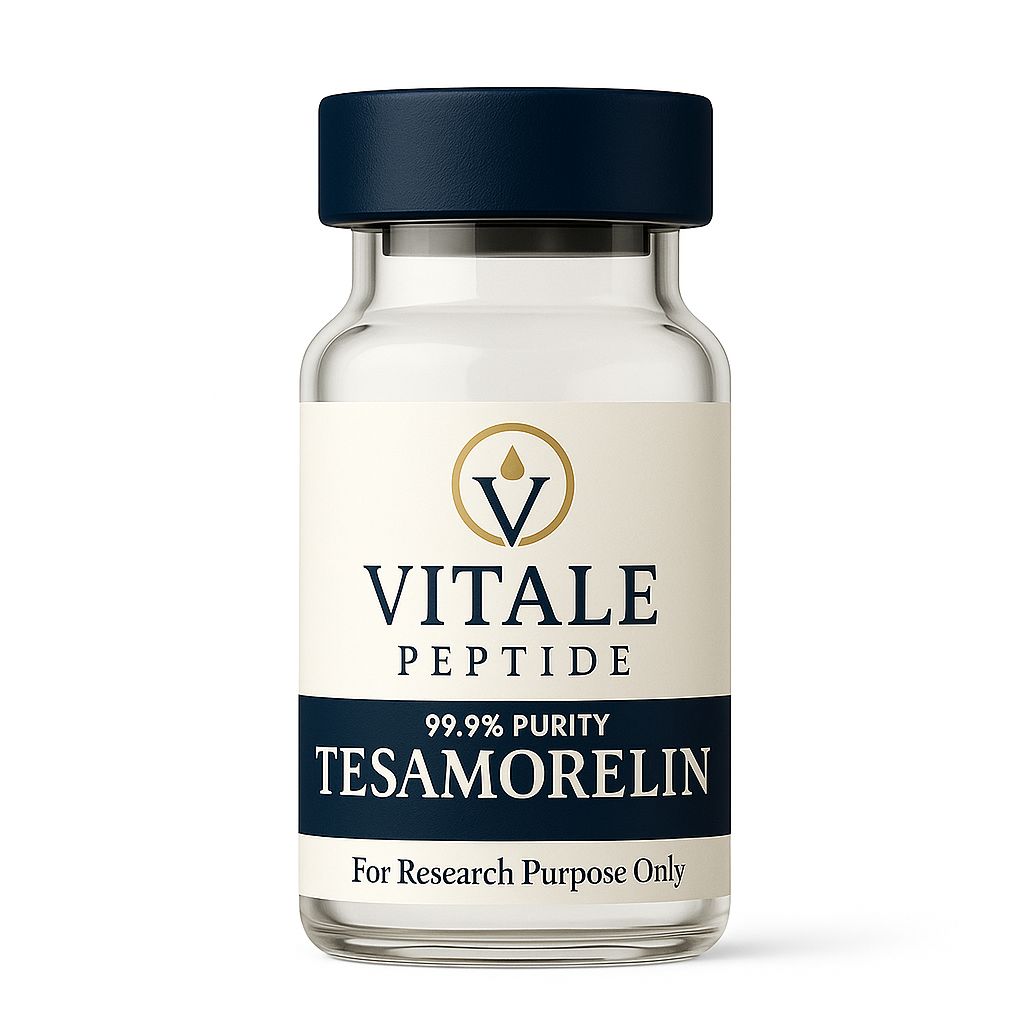
Tesamorelin (Tesa) ranks among the most extensively studied growth hormone-releasing hormone (GHRH) analogs in the research literature, largely because it carries the full 44-amino acid GHRH sequence with one key structural modification for stability. In this guide, we explain what Tesamorelin actually is, how its GHRH receptor mechanism works, what current research says about its metabolic and body-composition effects, and how it compares to other GHRH analogs like Sermorelin and CJC-1295. Consequently, whether you’re a lab researcher, a university procurement officer, or simply researching the terminology, this article gives you a clear, accurate, and up-to-date picture — sourced from current scientific literature and manufacturer research documentation.
Vitale Peptide supplies research-grade Tesamorelin to laboratories and institutions that need dependable, verified compounds for controlled studies. Before you evaluate a supplier or a study protocol, it helps to understand exactly what this molecule is and how it behaves at the receptor level.
Tesamorelin is a synthetic peptide analog that copies the first 44 amino acids of human growth hormone-releasing hormone (GHRH), with one added modification: a trans-3-hexenoic acid group attached to the N-terminus. This addition protects the peptide from rapid enzymatic breakdown, and as a result, researchers can study its effects over a more extended and predictable window compared to native GHRH.
Notably, Tesamorelin holds FDA approval under the brand name Egrifta for a specific clinical indication (reducing excess visceral fat in a defined patient population). However, that approval applies only to the regulated pharmaceutical product used under clinical supervision. The research-grade Tesamorelin that laboratories study is a distinct, unformulated compound intended exclusively for in-vitro and preclinical research applications — not for human or animal administration. Therefore, researchers should treat any research-use peptide as investigational material, separate from an approved drug product.
Tesamorelin’s research value centers on a single, well-characterized mechanism: GHRH receptor activation at the pituitary gland.
Because Tesamorelin retains the full native GHRH sequence, it binds the GHRH receptor on pituitary somatotroph cells in essentially the same way endogenous GHRH does.
Unlike direct growth hormone administration, Tesamorelin stimulates the pituitary to release growth hormone in its natural pulsatile pattern. Researchers consider this distinction meaningful, since pulsatile release preserves the body’s own feedback regulation instead of flooding the system with a constant, unregulated hormone level.
Once growth hormone reaches the liver, it stimulates production of insulin-like growth factor-1 (IGF-1), which then mediates many of the metabolic and cellular effects that researchers associate with the broader GH axis.
Consequently, researchers studying Tesamorelin often frame it as an upstream modulator rather than a direct hormone replacement — a distinction that shapes how study protocols get designed.
{ add image here — diagram showing the hypothalamic-pituitary-GH-IGF-1 axis }
| Compound | Structure | Primary Research Distinction |
|---|---|---|
| Tesamorelin | Full 44-amino acid GHRH(1-44) + stabilizing N-terminal group | Longest researched GHRH analog with the most extensive clinical trial dataset |
| Sermorelin | Truncated GHRH(1-29) fragment | Shorter half-life; represents the minimal active GHRH fragment |
| CJC-1295 | Modified GHRH fragment, often studied with or without a drug-affinity complex (DAC) | Extended half-life; studied for sustained GH pulsatility over longer intervals |
Overall, this comparison matters because researchers frequently substitute one GHRH analog for another without accounting for structural differences that affect receptor binding duration and study design.
Tesamorelin has one of the deeper clinical research datasets among GHRH analogs, largely because it went through formal drug-approval trials. Key points researchers should understand:
Because most of this data comes from the approved clinical formulation rather than unformulated research-grade peptide, researchers should account for that distinction when designing new studies or comparing results across sources.
Laboratories and institutions studying Tesamorelin typically investigate one or more of the following areas:
Since these applications require a compound with verified purity and consistent batch characteristics, sourcing quality matters just as much as the research question itself.
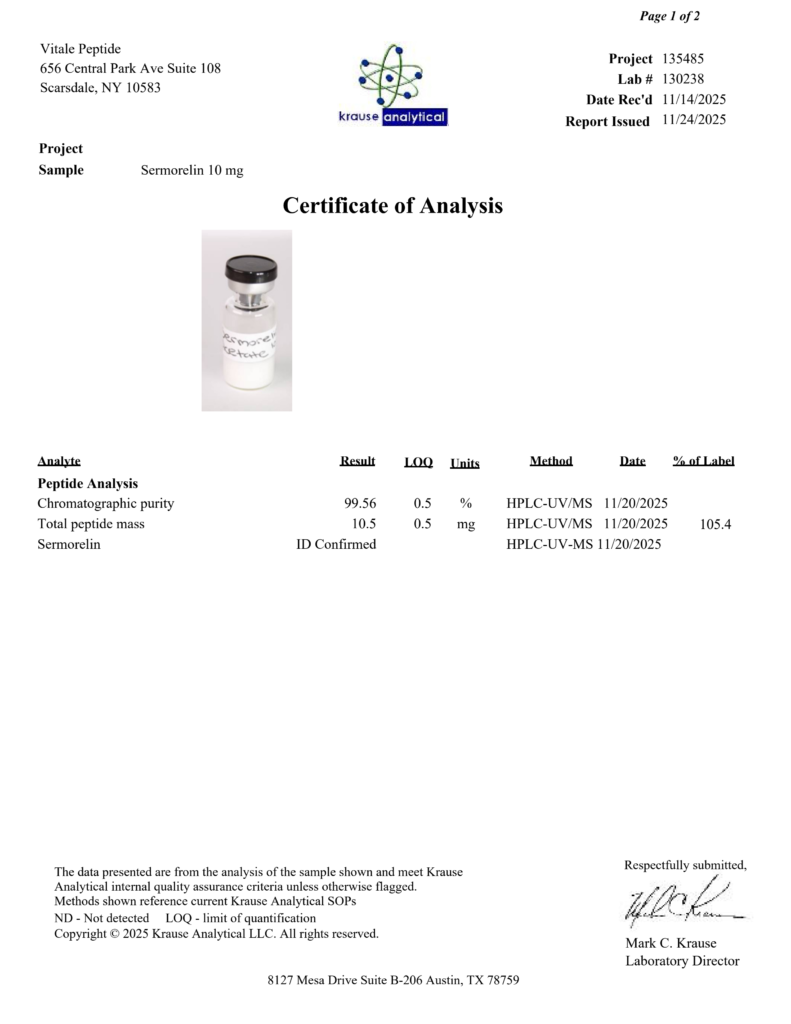
Research integrity depends on knowing exactly what’s in the vial. Therefore, when evaluating a supplier for Tesamorelin or any research peptide, look for:
Vitale Peptide includes this documentation with every batch of Tesamorelin we supply, so researchers can reference it directly in their own quality-control processes.
Peptide stability depends heavily on temperature, light, and moisture control, so proper handling protocols directly affect research validity:
{ add image here — lab freezer with organized, labeled research peptide vials }
What is Tesamorelin used for in research? Researchers study Tesamorelin primarily for its GHRH receptor activity, its role in stimulating pulsatile growth hormone release, and its downstream effects on IGF-1 signaling, visceral fat metabolism, and body composition.
Is Tesamorelin the same as Egrifta? Not exactly. Egrifta is the FDA-approved clinical formulation of Tesamorelin used under medical supervision for a specific indication. Research-grade Tesamorelin is a distinct, unformulated compound intended strictly for laboratory research, not clinical administration.
How does Tesamorelin differ from Sermorelin and CJC-1295? Tesamorelin carries the full 44-amino acid GHRH sequence with a stabilizing modification, while Sermorelin uses a shorter 29-amino acid fragment and CJC-1295 uses a modified fragment often studied for extended half-life.
How should researchers store Tesamorelin? Researchers should store lyophilized peptide at -20°C, refrigerate reconstituted peptide at 2–8°C, and use it within the supplier’s recommended timeframe.
Does Vitale Peptide provide documentation for research compliance? Yes. Every batch includes a Certificate of Analysis (COA) confirming purity and identity, which researchers can reference for their own quality-control records.
Is Tesamorelin approved for human use outside of Egrifta? No. Outside the specific FDA-approved Egrifta indication, Tesamorelin has no approved human use, and Vitale Peptide supplies it strictly for research purposes.
Tesamorelin stands out among GHRH analogs because of its well-documented mechanism and unusually deep clinical research dataset, spanning receptor binding, pulsatile GH release, visceral fat reduction, and downstream IGF-1 signaling. That said, researchers should keep the FDA-approved Egrifta formulation and unformulated research-grade peptide clearly separate when designing studies or interpreting existing data. As with any research compound, sourcing from a supplier that provides verified purity documentation remains essential to reliable, reproducible results.
Looking for research-grade Tesamorelin with full batch documentation? Browse our Tesamorelin research peptide listing or contact our team to request a Certificate of Analysis before you order.
Research Use Only. Not for human or animal consumption. This article is intended for informational and research-context purposes only